




 7 96
7 96

number
of
cigarettes
smoked
per
day)
[31] ,and
greater
nicotine
dependency
(measured
by
time
to
first
cigarette
after waking)
[32,33] .When
smoking
prevalence
is
high,
the mean
initiation
age
is
generally
<
20
yr
[3,34] .Those
who
start
smoking at earlier ages are generally exposed
to
smoke
for
longer
durations,
unless
they
quit
early
[35].
Before
the
tobacco
epidemic
starts
in
a
population,
the mean
age
of
initiation
is
usually
higher
than
after
the
epidemic
is
established;
in
the United
States,
for
example,
the mean
initiation
age was
35
yr
among women
born
in
1900
and
<
20
yr
in women
born
in
1940
and
afterward
[36].
Smoking
initiation
in
earlier
ages,
an
increase
in
smoking
intensity,
or
a
combination
of
both
can
substan-
tially
increase
the
magnitude
of
associations
between
smoking
and
diseases
in
a
population
over
time.
For
example,
the
relative
risk
of
lung
cancer
in
women
associated
with
current
smoking
in
the
United
States
increased
from 2.7
to 12.7
to 25.7
in
cohorts
in
the 1960s,
1980s,
and
2000s,
respectively
[35].
Patterns
of
smoking
intensity
vary
across
countries.
In
some Latin American
countries,
including Chile and Bolivia,
smoking
intensity
has
remained
relatively
low
(average
<
10
cigarettes per day) despite high
smoking prevalence
in
those
countries
[24] .In
contrast, average
smoking
intensity
increased dramatically
in China,
from 15
cigarettes per day
in
1980
to
22
cigarettes
per
day
in
2012
[24] .The
latter
pattern might be
seen more
commonly
in
LMICs
as
a
result
of
increases
in
income
and/or broader
cigarette
affordabili-
ty.
In some countries
that have managed
to
reduce
smoking
prevalence
through
successful
tobacco control polices,
such
as
Canada,
Denmark,
Iceland,
New
Zealand,
and
Uruguay,
persons who
continue
to
smoke
are usually heavy
smokers
[24]. These
intense
tobacco users, who are at a higher
risk of
smoking-related
diseases, may
need more
sustained
help
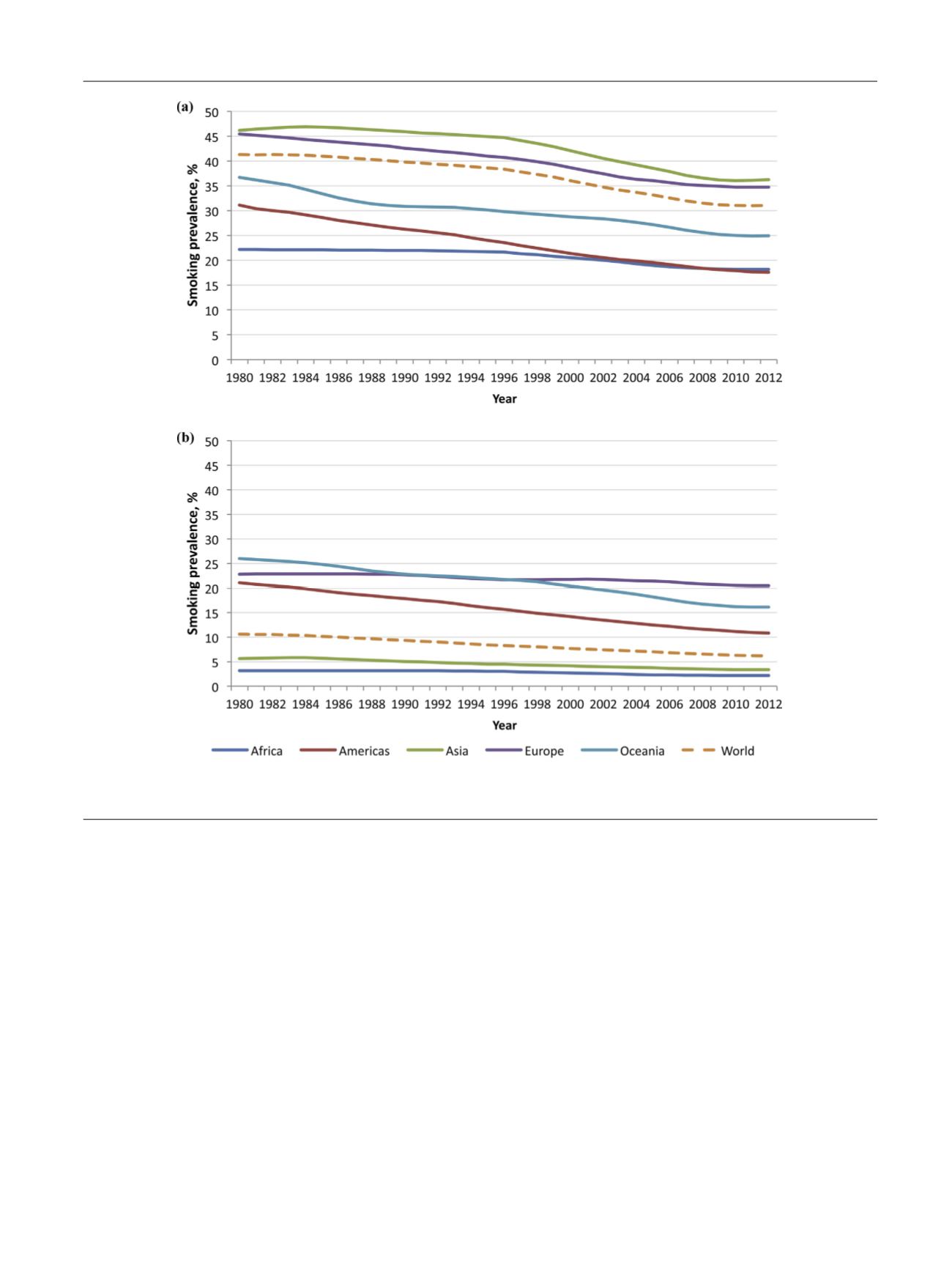
Fig.
2
–
Estimated
age-standardized
daily
smoking
prevalence
in
(a) men
and
(b) women
(aged
I
15
yr)
by
continent
(age-standardized
to
the
2000 world
standard
population)
[24].
E U R O P E A N
U R O L O G Y
F O C U S
1
( 2 0 1 5
)
3 – 1 6
7